
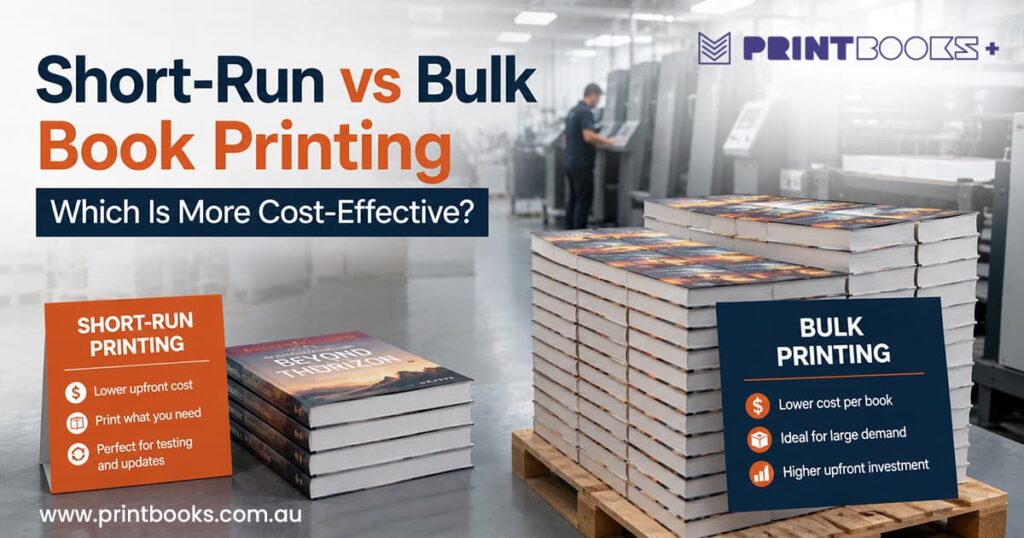
Choosing the right print quantity can have a major impact on the overall cost of a book printing project. Ordering too few copies may result in a higher price per book, while printing too many can leave you with excess stock and money tied up in inventory.
For authors, publishers, businesses, schools, organisations, and self-publishers, the decision often comes down to short-run vs bulk book printing.
So, which option is more cost-effective?
The answer depends on more than the number of books you order. Your budget, purpose, storage space, expected demand, turnaround time, and how often the book may need updating all play a role.
What Is Short-Run Book Printing?
Short-run book printing refers to producing a relatively small number of copies in a single print order. It is commonly used when you need anywhere from a few copies to a smaller batch for a specific project or audience.
Short-run printing is particularly useful for:
- Self-published authors
- Proof copies
- New book launches
- Training manuals
- Business books
- School publications
- Event programmes
- Limited-edition books
- Books with uncertain demand
One of the biggest advantages is flexibility. You can print what you need without committing to a large quantity upfront.
This can be especially helpful when you are testing a new title or are unsure how many copies you will sell.
What Is Bulk Book Printing?
Bulk book printing involves producing a larger quantity of books in one print run.
The main attraction is usually the lower cost per copy. As the number of books increases, the fixed costs associated with setting up the print job can be spread across more copies.
Bulk printing is often suitable for established titles, educational publications, corporate books, catalogues, novels, and projects where demand is relatively predictable.
If you already know that you will need hundreds or thousands of copies, bulk printing can often provide better value per book.
Short-Run vs Bulk Book Printing: The Main Difference
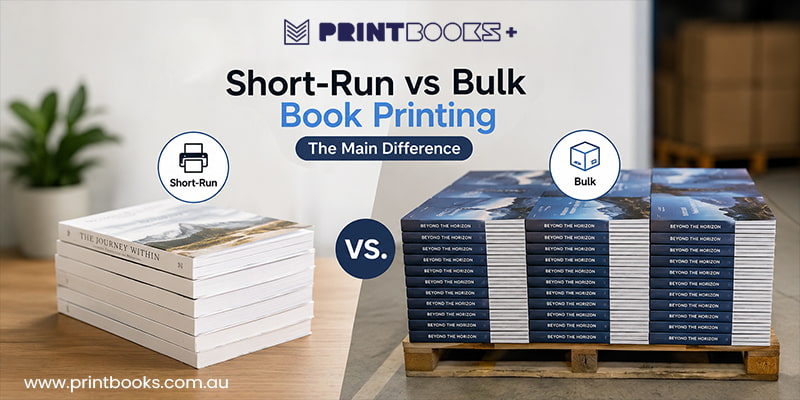
The biggest difference is the balance between unit cost and inventory risk.
Short-run printing generally offers greater flexibility but may have a higher cost per book. Bulk printing usually reduces the cost per copy but requires a larger upfront investment.
For example, printing 50 copies may cost more per book than printing 500 copies. However, ordering 500 copies only makes financial sense if you actually need most of them.
This is why the cheapest price per unit is not always the same as the lowest overall cost.
Is Short-Run Book Printing More Cost-Effective?
Short-run printing can be more cost-effective when your expected demand is low or uncertain.
Imagine you are publishing your first book and have no reliable sales history. Ordering a large quantity simply to reduce the unit price could create unnecessary financial risk.
With a short print run, you can produce a manageable number of copies, sell or distribute them, and then place another order when required.
This approach can reduce:
- Upfront printing costs
- Storage requirements
- Risk of unused stock
- Waste from outdated content
- Financial pressure on new projects
For new authors and small businesses, this flexibility can sometimes be more valuable than achieving the lowest possible unit price.
When Does Bulk Printing Make More Financial Sense?
Bulk printing becomes increasingly attractive when you have predictable demand.
If you know you need 1,000 copies for a book launch, conference, educational programme, or retail distribution, printing a larger quantity in one run can reduce the cost per book.
Bulk printing may also be appropriate when:
- The book has consistent sales
- You have confirmed orders
- You are supplying multiple locations
- The content will remain unchanged
- You have adequate storage
- You need a large quantity at once
When demand is reliable, the savings from a lower unit price can outweigh the additional upfront investment.
Print Quantity Isn't the Only Cost to Consider
It is easy to focus only on the quoted price per book, but that does not tell the complete story.
When comparing short-run and bulk printing, consider the total cost of the project.
This may include:
- Printing and binding
- Shipping or delivery
- Packaging
- Storage
- Handling
- Inventory management
- Reprinting
- Content updates
- Unsold stock
For example, bulk printing might offer a lower price per copy, but if half the books remain in storage for several years, the apparent saving may not be as attractive as it first appears.
What About Print-on-Demand?
Print-on-demand is another option worth considering for books with unpredictable demand.
Instead of holding a large inventory, books are printed when copies are needed. This can reduce storage requirements and minimise the risk of being left with unsold stock.
The trade-off is that the cost per copy can be higher than a larger bulk print run.
For authors who sell books gradually rather than in large quantities, this model can still make practical and financial sense.
Which Book Printing Option Is Right for You?
The choice between short-run and bulk book printing ultimately comes down to your individual project.
Choose short-run printing when flexibility, lower upfront investment, and reduced inventory risk are your priorities.
Choose bulk printing when you have predictable demand, sufficient storage, and a clear need for a large number of copies.
The most cost-effective approach is not necessarily the one with the lowest price per book. It is the option that gives you the right balance between printing cost, quantity, demand, storage, and future requirements.
Make Your Print Run Work for Your Budget
Before placing your book printing order, consider the complete cost of producing and managing your books rather than focusing only on the initial quote.
For book printing services in Australia, Printbooks offers a range of coated, uncoated and recycled stocks alongside different book formats and binding options.
For a new title or smaller project, starting with a short run can give you the flexibility to test demand without committing to a large inventory. For an established title with reliable demand, bulk printing can help bring the cost per copy down and make your budget work harder.
At Print Books, choosing the right printing quantity starts with understanding what your project actually needs. By matching your print run to your expected demand, you can avoid unnecessary stock while still getting good value from your book printing investment.