
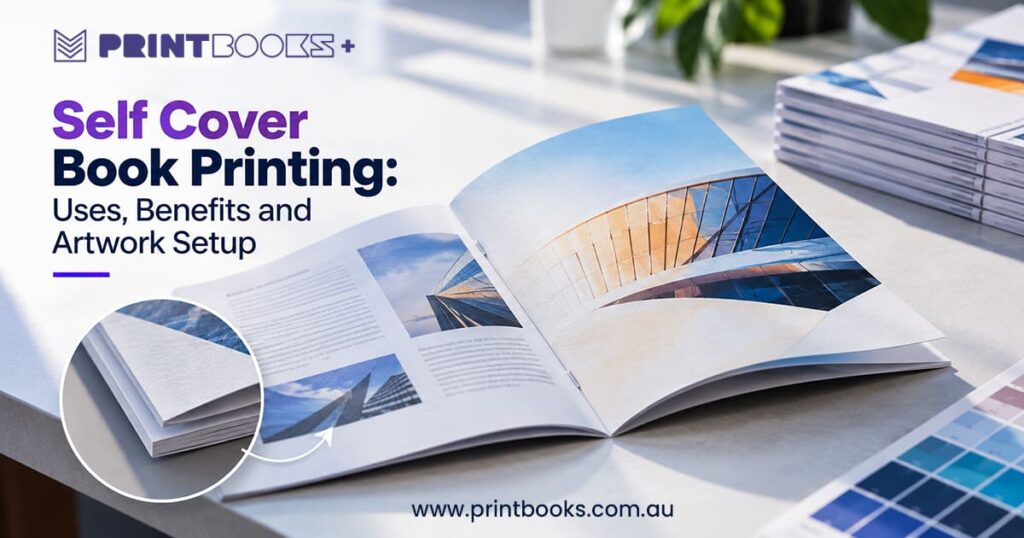
Most booklets and catalogues get a heavier paper for the cover than for the pages inside. You don’t always need that. Self cover book printing uses the same stock for the cover and the inner pages, so you get a clean finish without paying for a separate, thicker cover.
For businesses, publishers and organisations printing booklets, reports, newsletters or event programmes, it keeps production simple and the finished piece light and easy to hand out.
Here’s how self-cover books work, what suits them and how to set up your artwork before you order.
What Is Self Cover Book Printing?
It’s a method where the cover and the internal pages share one paper stock. Nothing thicker on the outside, just the same weight all the way through.
Picture a 24-page company newsletter with the front cover, inside pages and back cover all on the same paper. It’s simple and light, and there’s no extra stock to source.
It’s mostly used for saddle-stitched booklets and some spiral-bound publications. Magazines, newsletters, brochures, comic books, price lists and short business publications all suit it.
What matters is what the piece is for. If it goes out regularly, has a short shelf life or just needs to get information across, self cover is worth a look.
What Are the Benefits of Self Cover Books?
A More Cost-Effective Printing Option
You skip specifying a separate, heavier cover stock. That simplifies material choices and can help the budget, especially on newsletters, programmes and internal reports printed in bigger runs.
Final cost still depends on page count, paper, colour, binding and quantity. Compare the full specs of both options rather than judging on paper weight alone.
Lightweight and Easy to Distribute
One stock throughout means copies are lighter to pack, post and carry. That’s handy if you’re mailing product info or handing out programmes at an expo, and on a large run the weight difference can affect packaging and postage.
Consistent Appearance Across Every Page
The cover and pages feel the same, which suits publications where the content matters more than a premium cover. A community newsletter or internal update doesn’t need thick card to look professional. Good layout, clear type and the right paper do the job.
Simpler Artwork and Production Planning
One paper spec instead of two makes planning easier for simple publications. Artwork still needs to depend on the binding, though, so ask your printer whether the cover goes in the same PDF as the inside pages or as a separate file.
Which Publications Are Best Suited to Self Cover Printing?
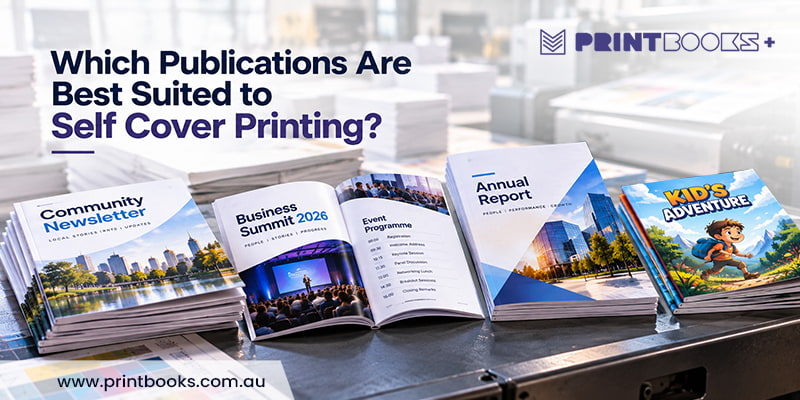
Anything that needs a practical, economical format rather than a rigid or premium cover.
Newsletters and Magazines
A good fit when you want light handling and consistent paper, especially if copies go out often or in volume.
Event Programmes and Conference Booklets
Schedules, speaker bios, venue details and sponsor info all fit without adding bulk.
Business Reports and Information Booklets
Internal updates, short reports and company info booklets work well if they don’t need a separate cover for protection or presentation. If it’ll be kept for years or handed to senior stakeholders, go heavier.
Comic Books and Promotional Publications
Some comics, promo booklets and illustrated pieces can use self cover, depending on the finish and binding. Let image quality, paper and the reading experience guide you, and talk page count, artwork and use through with your printer first.
Self Cover vs Separate Cover Books: Which Should You Choose?
The difference is the cover paper.
Self cover uses one stock throughout. It suits lightweight publications, regular updates and tight budgets.
Separate cover uses a different, usually thicker stock. You get more stiffness and a more substantial feel, which helps when you want more impact or protection.
Neither is automatically better. It depends on your budget, the purpose, how it’ll be handled and the finish you want. Wide distribution and short use? Self cover makes sense. Needs a stronger presentation or repeated handling? A heavier cover may be worth the extra.
How to Prepare Artwork for Self Cover Book Printing
Get the setup right and you avoid delays and nasty surprises.
Confirm the Finished Size and Page Count
Settle on the final size before you design. A4 and A5 are common, but it depends on the content and how it’ll be used. For saddle-stitched books the page count generally needs to be divisible by four. Other binding methods have their own rules, so check before you finalise.
Use Consistent Paper and Cover Specifications
Because the stock is the same throughout, think about how it’ll reproduce text, photos and colour on the cover. A text-heavy newsletter needs readability. A photo-led booklet needs paper that handles images well.
Set Up Bleed and Safe Margins
If backgrounds, photos or colour run to the edge, add bleed beyond the trim. PrintBooks’ artwork setup guide recommends print-ready PDFs, CMYK colour mode, 300 dpi at 100% size, 3 mm bleed on all edges and a 15 mm safety margin. Keep text, logos and anything essential inside the safe area so it doesn’t get trimmed off.
Prepare the PDF in the Correct Page Order
For self-cover saddle-stitched work, the cover pages may need to sit in one multi-page file with the inside pages. PrintBooks’ guidance says saddle-stitched cover artwork goes in as single pages, not a spread, covering the front cover, inside front cover, inside back cover and back cover. Confirm the arrangement with your printer first, since binding methods differ.
Proofread and Check the Final File
Before you approve the run, check page order, spelling, image resolution, margins, colour and contact details. Look hard at the front and back covers, because mistakes there hurt most. Ask for a proof if the project has important business info, a complex layout or a big quantity.
Order Self Cover Books with PrintBooks
Choosing the right paper and binding early means you get what you need without paying for features you won’t use.
PrintBooks does book printing and binding for lots of publication types, with options for different formats and projects. Business booklet, newsletter, event programme or promo piece, confirm your paper, binding and artwork setup before you order.
Planning a self-cover project? Contact PrintBooks to talk through your specs and get a quote for your next run.