
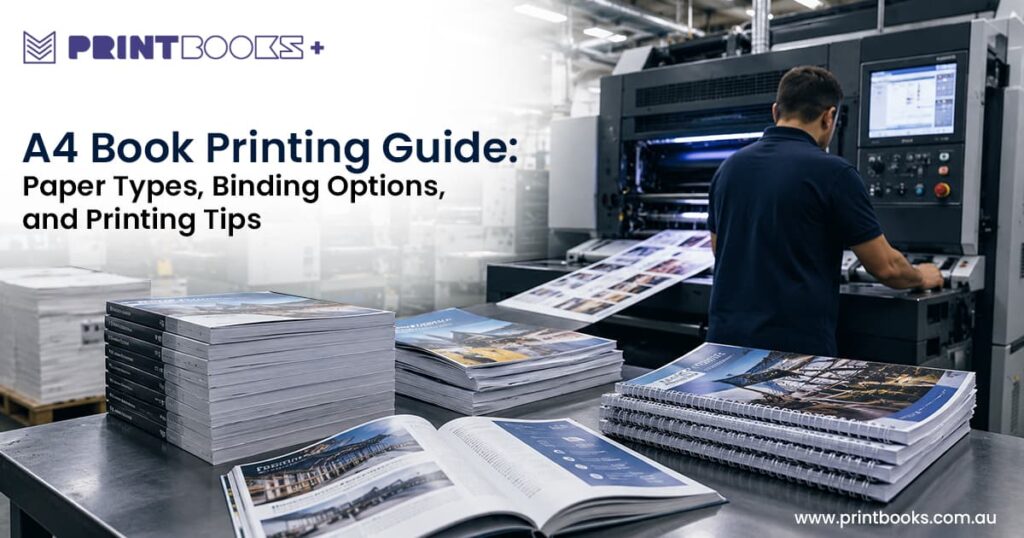
When it comes to printing manuals, reports, catalogues, workbooks, or company documents, A4 book printing is one of the most practical and widely used formats. The larger page size gives you more room to work with — text breathes better, images reproduce clearly, and charts or diagrams don’t end up crammed into corners. If presentation matters to you, it’s hard to go past A4.
A lot of people put all their energy into the design and don’t think much about the actual printing side of things. But the decisions you make around paper, binding, and file preparation have a real impact on how the finished book looks and holds up over time. Getting across these basics before you place an order can save you from headaches down the track.
What Is A4 Book Printing?
A4 is the standard 210 × 297 mm page size most of us have grown up with, and for good reason — it’s familiar, practical, and versatile. The extra real estate on each page means you can fit more content without things feeling cluttered, which is why it’s the go-to format for anything that needs to communicate detailed information clearly.
It’s not a format chasing portability. A4 is about readability and function. Training manuals, product catalogues, annual reports, educational materials, instruction guides — these all work well at A4 because you’ve got the room to display large tables, technical drawings, and full-page images without asking readers to squint or unfold anything.
It also scales well across print volumes. Whether you need a short digital run of 20 copies or an offset run in the thousands, A4 works across both without issue.
Choosing the Right Paper Type
Paper tends to be the last thing people think about, but it genuinely shapes how a finished book feels in your hands and reads on the page. The right stock should suit your content — not just your budget.
For text-heavy books like manuals or workbooks, uncoated paper is usually the better call. It’s easy on the eyes for extended reading, and people can actually write on it — useful if the book is meant to be filled in or annotated during training sessions or classes.
If your publication is image-led — product photography, colourful graphics, marketing content — coated paper will serve you better. Gloss stock makes colours pop and gives images a crisp, vibrant finish. If you want that same image quality without the shine, silk or matte coated paper is worth considering. It prints beautifully while staying easy to read in most lighting conditions.
Paper weight matters too. Lighter stocks make sense for high page counts where the book needs to stay manageable. Heavier stocks add a premium feel. Covers should always be on thicker cardstock — it protects the pages and gives the whole book a more finished, durable look.
Selecting the Best Binding Option
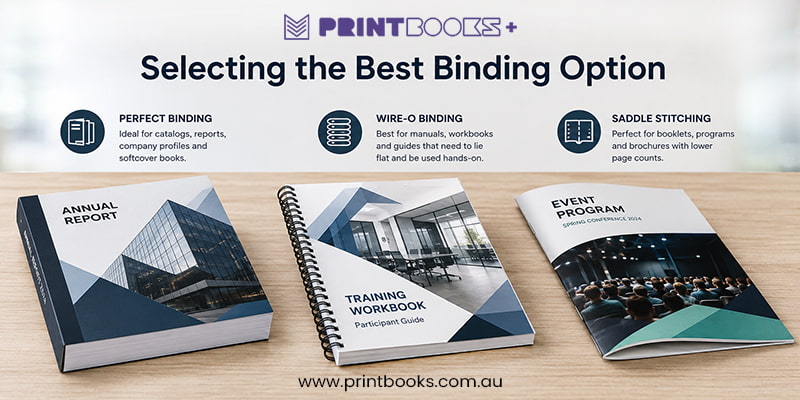
Binding is more than an aesthetic choice — it affects how usable the book actually is in practice. Think about where and how the book will be used before you decide.
Perfect binding is the most common choice for professionally produced books. It gives you a flat square spine that can be printed with a title or logo, and it suits catalogues, reports, company profiles, and softcover publications well. It’s clean, cost-effective, and looks the part.
For manuals, workbooks, and training guides that people need to use hands-on — propped open on a desk, written in during a workshop — wire or coil binding is far more practical. Pages lie completely flat, which makes a real difference when someone is trying to read and write at the same time.
Saddle stitching suits thinner publications. Booklets, event programmes, brochures — it’s a tidy, affordable finish for lower page counts.
The right binding doesn’t just look good; it makes the book easier to use and means it’ll hold together through regular handling. That’s worth thinking about.
Printing Tips for Professional Results
Good print results come from paying attention to the details — not just designing something that looks good on screen.
Start by thinking about your audience and how they’ll actually use the book. A catalogue full of product photography calls for gloss paper. A workbook people will write in needs uncoated stock. Matching your materials to the purpose of the publication makes a real difference to the experience.
For larger runs, always ask for a proof before you commit to the full quantity. It gives you a chance to check colours, paper, alignment, and overall feel while changes are still straightforward. Skipping this step to save time is rarely worth it.
If you’re not sure what options to go with, a good printing company should be able to talk you through what suits your specific project. You shouldn’t need to figure it all out alone.
Common Mistakes to Avoid
Most printing problems trace back to simple things that got missed. Choosing paper purely on price. Sending through low-resolution images. Picking a binding method without thinking about how the book will actually be used. These are avoidable mistakes, but they come up constantly.
File setup catches a lot of people out too. Wrong page dimensions, missing bleed, fonts that haven’t been embedded — these issues cause production delays that could’ve been avoided with a proper check before submission.
Don’t rush the proofreading either. Once a book is printed, fixing errors means starting the print run again. It’s worth taking the extra time.
Conclusion
A4 book printing has stuck around as a reliable format because it works. The size suits a wide range of content, it’s readable, and there’s enough room to include proper visuals and branding without compromising the layout. Pair it with the right paper and binding, and you’ve got a publication that does its job well and reflects well on whoever produced it.
Every project is different, so there’s no single answer that fits everything. Knowing your audience, choosing materials that match your content, and submitting properly prepared files — those are the things that lead to a result you’re happy with. Whether it’s a training manual, a product catalogue, an annual report, or an educational resource, getting these fundamentals right is what separates a good book from a forgettable one.