
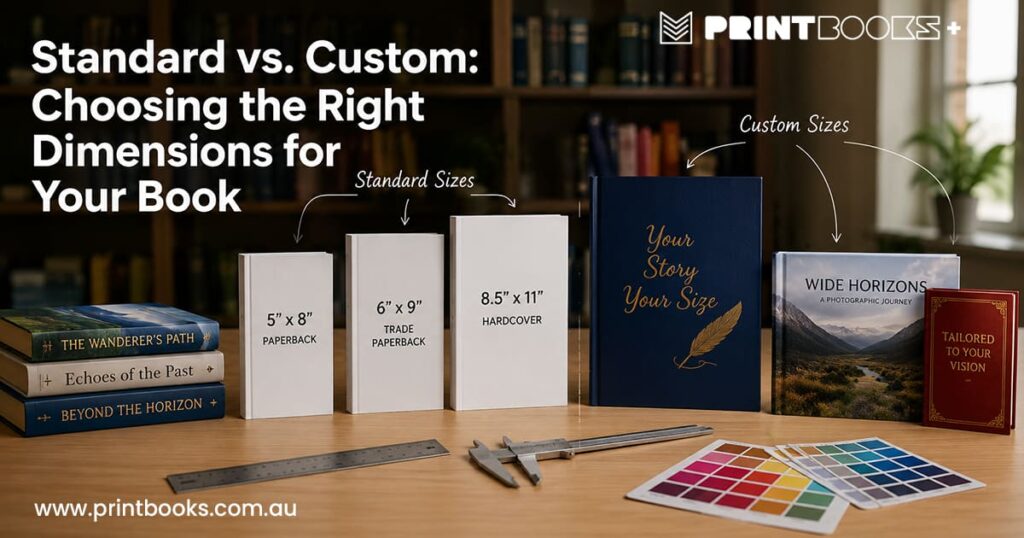
Before a single page goes to press, one decision quietly shapes everything else about your project: the size of the book itself. It affects your printing costs, your paper stock options, how the book feels in a reader’s hands, and even how it looks sitting on a shelf next to everything else. Yet it’s one of the most overlooked choices in the entire book printing process.
So, should you go with a standard book size or invest in custom dimensions? The honest answer is “it depends” — but knowing what it depends on will save you time, money, and a few headaches down the track.
Why Book Dimensions Matter More Than You'd Think
Every book format sends a signal before a reader even opens the cover. A slim A5 novel says “read me on the train.” A generous A4 says “I’m a reference guide, a workbook, or a coffee table piece.” Dimensions influence the printing process at every stage — from how efficiently pages are imposed on a print sheet to how the book binds, opens, and lies flat.
Get the size wrong, and you might end up with a book that feels flimsy in hand, wastes paper (and money) during printing, or simply doesn’t suit its purpose. Get it right, and the physical object reinforces exactly what you’re trying to say with the content inside.
Standard Book Sizes: The Reliable Choice
Standard sizes exist for good reason. Formats like A4, A5, and A6 are the backbone of book and booklet printing in Australia, and they’re popular for a simple reason: efficiency.
Common standard sizes include:
A4 (210 x 297mm):
ideal for manuals, workbooks, textbooks, reports, and any project where readability and space for diagrams or images matter
A5 (148 x 210mm):
the go-to trim size for novels, journals, notebooks, and memoirs; compact enough to hold comfortably, spacious enough to read easily
A6 (105 x 148mm):
perfect for pocket-sized diaries, zines, or small giveaway booklets
Because these dimensions align with standard paper stock sizes, printing in these formats typically means less waste, faster turnaround, and a more cost-effective print run — particularly useful for short and long print runs alike. If you’re printing children’s books, paperbacks, colouring books, or activity books at scale, sticking to a standard format is often the smartest commercial decision you’ll make.
There’s also a practical upside for authors and publishers: standard sizes fit neatly into existing distribution channels, display racks, and mailing packaging, which matters if your book is heading to retail or needs to travel.
Custom Book Dimensions: When It's Worth the Investment
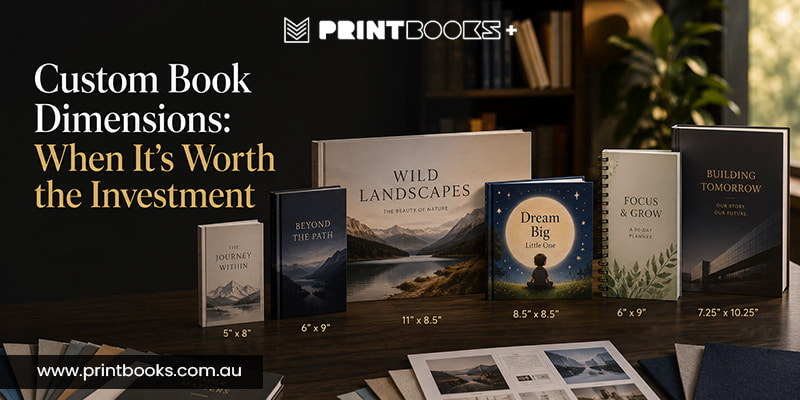
Custom sizing isn’t about vanity — it’s about intention. Sometimes a project simply doesn’t fit into an off-the-shelf format, and forcing it to would undersell the finished product.
Custom dimensions tend to make sense for:
Photobooks and coffee table books:
where a wider, squarer format shows off imagery properly
Children’s books:
where an unusual trim size adds personality and shelf appeal
Lookbooks and fashion journals:
where the format itself becomes part of the brand experience
Calendars, yearbooks, and programmes:
which often need specific proportions to work with their content and layout
Corporate or branded books:
where the finished product needs to match packaging, portfolios, or existing collateral
Custom page layout also gives you creative control over binding style. A slightly larger custom trim might suit a hardcover book with a dust jacket, while an unconventional narrow format could complement spiral binding or wiro binding for a workbook that needs to lie flat. The trade-off is usually cost and lead time — custom sizes often require more careful planning around paper stock, imposition, and finishing, so they suit projects where the visual impact justifies the extra investment.
Questions to Ask Before You Decide
Choosing between standard and custom dimensions gets much easier once you’re clear on a few basics:
What’s the purpose of the book?
A textbook has very different requirements to a memoir or a photobook. Function should always lead form.
Who’s the reader, and how will they use it?
A pocket diary needs to be pocket-sized. A reference manual needs room to breathe. Think about how the book will actually be held, read, and stored.
What’s your print run and budget?
Larger runs generally favour standard sizes, since they make the most efficient use of paper stock and printing presses. Smaller, more premium runs have more room for custom formats.
What binding and finishing do you want?
Perfect binding, saddle stitching, section sewn binding, hardcover, or softcover — your chosen binding method can influence which sizes work best structurally.
Does the book need to match a series, brand, or existing product line?
If you’re printing a follow-up title or a set of matching journals, consistency in size might matter more than either standard or custom convention.
Finding the Right Fit for Your Project
There’s no universally “better” option between standard and custom book sizes — only what’s better for your specific book. A well-chosen standard format can look just as premium and considered as a custom one, provided it suits the content, the reader, and the purpose. Equally, a thoughtfully chosen custom dimension can turn a good book into a genuinely memorable object.
At Printbooks, we work with authors, publishers, and businesses across Australia to print everything from A4 workbooks and A5 novels to fully custom photobooks and branded lookbooks — in short and long runs, on a wide range of paper stocks, with the binding and finishing options to match. If you’re not sure which direction suits your project, our team can talk you through the options, or you can request a free sample pack to see and feel the different formats for yourself before committing.
Whatever size you land on, the goal is the same: a finished book that looks right, feels right, and does justice to the work you’ve put into it.