
Paperback books have been around for generations, and despite everything moving online, they’re still everywhere. Walk into a bookstore, attend a conference, visit a school, or even browse product catalogues at an event — paperback formats continue to dominate. There’s a reason for that. They’re practical, affordable, easy to distribute, and comfortable to read.
For businesses, paperback books make sense because they keep printing costs manageable while still looking polished and professional. For authors, especially self-publishers, they offer a realistic way to bring a book to life without the huge production costs that come with hardcover printing.
At Print Books, we’ve seen businesses, educators, and independent authors consistently choose paperback book printing because it gives them flexibility without compromising on presentation. Whether it’s a training manual, a novel, a workbook, or a company catalogue, paperback books continue to be one of the most reliable print solutions available.
What Are Paperback Books?
Paperback books are books printed with flexible soft covers instead of rigid hardcover materials. They’re lightweight, easier to carry around, and far more economical to produce, which is why they’re so widely used across publishing and business printing.
You’ll see paperback books used for almost everything:
- Fiction and non-fiction titles
- Educational resources
- Training manuals
- Product catalogues
- Workbooks
- Business presentations
- Promotional publications
For many readers, paperback books simply feel more practical. They’re easier to handle, less bulky, and usually more affordable to buy compared to hardcover editions.
From a business perspective, they also make large-scale printing far more realistic financially.
Why Paperback Books Are So Popular
Affordable Printing and Production
One of the biggest reasons paperback books continue to outsell many other formats comes down to cost. Printing a hardcover book involves more materials, more production time, and higher finishing costs. Paperback books simplify that entire process.
That’s especially important for:
- Independent authors printing their first books
- Businesses producing training materials
- Schools ordering educational resources
- Companies creating catalogues or guides
The lower production cost means businesses can print more copies without stretching their budgets too far.
And honestly, most readers aren’t overly concerned about whether a book has a hard cover or a soft cover. If the content is valuable and the print quality is good, paperback works perfectly well.
Lightweight and Portable
Easy for Readers to Carry
This is probably one of the most overlooked advantages of paperback books. People actually like carrying them.
A heavy hardcover might look impressive sitting on a shelf, but paperback books are simply easier to use in day-to-day life. They fit into bags more easily, they’re lighter to hold during long reading sessions, and they don’t take up as much space.
For students, travellers, and office professionals, portability matters more than people realise.
The same applies to businesses distributing printed materials at trade shows, conferences, or training sessions. When you’re handing out hundreds of books or manuals, lightweight formats make logistics much easier.
Professional Appearance at Lower Cost
High-Quality Presentation
A lot of people still assume paperback books look “cheap,” but modern printing has changed that completely.
Today’s paperback book printing can look incredibly professional when done properly. Matte finishes, gloss covers, premium paper stocks, sharp colour printing, and clean binding all contribute to a polished final product.
At Print Books, many clients are surprised by how premium custom paperback books can feel once the right materials and finishes are used.
In many cases, readers won’t even think twice about whether a book is paperback or hardcover. What stands out more is the overall print quality and design.
Types of Paperback Books
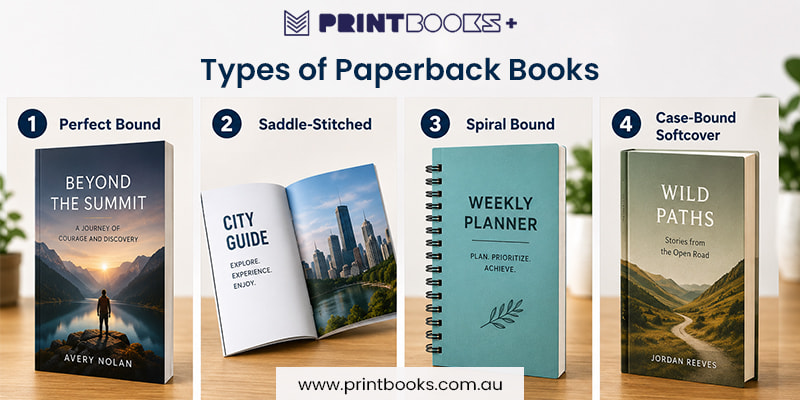
Perfect Bound Paperback Books
Perfect binding is probably the format most people picture when they think of paperback books. The pages are glued together at the spine with a wraparound cover, creating a clean square-edge finish.
This style is commonly used for:
- Novels
- Company profiles
- Educational books
- Product catalogues
- Manuals
It’s popular because it strikes a good balance between durability, presentation, and affordability.
For businesses wanting a professional-looking publication without excessive printing costs, perfect binding is usually the first choice.
Saddle-Stitched Paperback Books
Saddle stitching is more commonly used for smaller publications. Instead of glue binding, pages are stapled together through the fold line.
You’ll often see this format used for:
- Event booklets
- Short guides
- Promotional brochures
- Small catalogues
- Programs
It’s simple, cost-effective, and works well when page counts are lower.
Not every project needs a thick professionally bound book. Sometimes a straightforward saddle-stitched format does the job perfectly.
Spiral Bound Paperback Books
Spiral binding is practical more than anything else. It’s commonly chosen for books that need to stay open flat on a desk or workspace.
That’s why businesses frequently use it for:
- Training manuals
- Instruction guides
- Workbooks
- Educational resources
- Recipe books
It may not have the sleek appearance of perfect binding, but from a usability standpoint, spiral binding is extremely effective.
Case-Bound Softcover Books
Some projects need something slightly more premium while still maintaining the flexibility of paperback formatting.
Case-bound softcover books offer a sturdier feel without going fully hardcover. They’re often used for:
- Premium company presentations
- Photography books
- High-end catalogues
- Branded publications
This option works well for businesses wanting a stronger visual impact without the full cost of hardcover production.
Popular Printing Options for Paperback Books
Digital Book Printing
Digital printing has become incredibly popular for short-run paperback book printing, especially among self-publishing authors and smaller businesses.
One reason people like digital printing is flexibility. You don’t need to commit to massive quantities upfront.
It works particularly well for:
- Limited print runs
- Author copies
- Print-on-demand books
- Small business publications
Turnaround times are usually faster too, which helps when deadlines are tight.
Offset Book Printing
Offset printing is still the preferred choice for larger-scale printing projects.
If a business or publisher needs thousands of copies, offset printing becomes more economical and consistent over long production runs.
It’s commonly used for:
- Educational textbooks
- Retail book distribution
- Large catalogue runs
- Commercial publishing projects
The setup process takes longer compared to digital printing, but for high-volume jobs, the print consistency and cost efficiency make it worthwhile.
Black and White vs Full-Colour Printing
Black and White Paperback Books
Black and white printing continues to be the most practical option for text-heavy publications.
Novels, educational guides, instructional manuals, and workbooks often don’t require colour pages, so keeping them black and white helps reduce costs significantly.
For many projects, simplicity works better anyway.
Full-Colour Paperback Books
Some books rely heavily on visuals, and in those cases, colour printing makes a major difference.
This is especially true for:
- Product catalogues
- Photography books
- Children’s books
- Cookbooks
- Marketing materials
Good colour printing immediately improves presentation and creates a more engaging reading experience.
Choosing the Right Paper for Paperback Books
Uncoated Paper
Uncoated paper is often used for novels and educational books because it feels natural to read on for long periods.
It also reduces glare, which many readers prefer.
Gloss-Coated Paper
Gloss paper is usually chosen when images and colours need to stand out more clearly.
That’s why it’s commonly used for catalogues, promotional publications, and photography-heavy books.
Matte-Coated Paper
Matte paper sits somewhere in between. It gives books a softer, more refined appearance without the shine of gloss finishes.
A lot of businesses prefer matte finishes because they look clean and modern.
Why Businesses Choose Paperback Books
Cost-Effective Marketing and Publishing
Businesses print more paperback books than many people realise.
Training manuals, product catalogues, onboarding guides, promotional publications, and internal company documents are often produced using paperback book printing because it keeps costs under control while still looking professional.
For companies distributing large quantities, affordability matters just as much as appearance.
That’s where paperback formats really stand out.
Ideal for Self-Publishing Authors
Easier Market Entry
For independent authors, paperback books make publishing far more accessible.
Instead of investing heavily into expensive hardcover production, authors can launch professionally printed custom paperback books with far lower upfront costs.
That flexibility matters, especially for first-time authors testing the market.
Many self-published writers now start with paperback editions before expanding into hardcover or special editions later on.
Paperback Books vs Hardcover Books
Hardcover books definitely have their place, especially for collector editions or premium releases. But they also come with higher production costs, heavier materials, and more expensive distribution.
Paperback books tend to be more practical for everyday use.
They’re easier to carry, cheaper to print, and far more suitable for large-scale distribution. That’s why most businesses, schools, and independent authors continue to prefer paperback formats for general publishing.
Why Choose Print Books for Paperback Book Printing?
At Print Books, we work closely with businesses, publishers, schools, and self-publishing authors to create professionally finished custom paperback books that are designed for real-world use.
We provide:
- Professional binding options
- Premium paper selections
- Custom sizing
- Full-colour and black-and-white printing
- Bulk printing services
- Fast turnaround times
Whether it’s a short-run project or a large commercial order, our focus stays the same — producing high-quality paperback book printing solutions that look professional, feel durable, and represent your brand properly.
The Future of Paperback Book Printing
Even with digital publishing continuing to grow, paperback books aren’t disappearing anytime soon.
People still enjoy physical books. Businesses still rely on printed materials. Schools and training organisations still need practical printed resources.
What’s changing is the technology behind the printing process itself.
Modern paperback book printing is faster, more efficient, and more environmentally conscious than it was years ago. Print-on-demand services, sustainable paper options, and improved digital printing technology are all helping businesses and authors produce books more efficiently.
And realistically, there’s still something about holding a physical book that digital formats simply can’t replace.